Stays on is now Always-on in v0.5.1
7 features · 84 fixes · 3 performance changes
Highlights
Stays on is now Always-on in v0.5.1
The agent kind that keeps running on its own is now called Always-on, and its value is always_on. Every CompozyOS surface uses the new name: the app, the CLI, config.toml, HTTP/UDS, native tools, the SDKs, the official skill, and the docs. On-demand agents are unchanged. The app now also uses the labels other agent tools use for permission levels and agent setup:
- Permission levels: Accept edits (
approve-edits, was "Edit on its own"), Auto-review (auto, was "Let a reviewer decide"), and Full access (approve-all, was "Never ask"). Wire values are unchanged. - The agent page section is Setup: Instructions, Model, Heartbeat, Memory, Tools, and Permissions. A scheduled check now reads "heartbeat". Page URLs are unchanged.
Migration
v0.5.1 upgrades in place: v0.5.0 files, config, request values, and stored rows keep working through v0.5.1. Readers of emitted kind, reason, and error values must update now (see below). Every alias below is removed in v0.5.2.
- Update the daemon together with the CLI. The CLI doesn't check the daemon's version. A v0.5.1 CLI always sends
always_on, which a v0.5.0 daemon rejects. - AGENT.md
kind: stays_on→kind: always_on. The old value loads asalways_onthrough v0.5.1, and the daemon logs one warning per file. On boot, the daemon rewrites thekindvalue of every AGENT.md under$COMPOZY_HOME/agentsand$COMPOZY_HOME/profiles/<profile>/agents. It changes no other byte and logs each rewrite and each skip. AGENT.md files in a repository, a workspace profile, or an extension are never rewritten, so edit those yourself before v0.5.2. [agents.stays_on]→[agents.always_on]. The old table is read with one warning per process, and a key set in[agents.always_on]wins.compozy config get|set|unsetandcompozy__config_*acceptagents.stays_on.*paths, warn, and operate onagents.always_on.*.unsetthrough either spelling clears the key from both tables in the file it edits. Defaults are unchanged.--kind stays_on→--kind always_on. The CLI accepts the old value with a stderr warning.- Request enums vs. emitted values. Request
kindfields (create, update, duplicate, itsoverrides.kind, andcompozy__agent_create) accepton_demand,always_on, or the deprecatedstays_on. The generated TypeScript and Go request types widen to match. Responses, events, tool results, and CLI-o jsonemitalways_onfrom this release on, so readers that comparekindtostays_onbreak now. definition_not_stays_on→definition_not_always_on. This changes at once in the instance APIpause_reasonfield, the instance checkgate(compozy agent instance checkandcompozy__agent_instance_check), the check-in historyreason, and theagent.instance.*hook payloadreason. Stored rows are migrated. Hook consumers that compare the old value break.agent_not_stays_on→agent_not_always_on. The error code changes at once. The experimental agent memory routes break with no compatibility window.- Startup section
stays_on_doctrine→always_on_doctrine. The tag is now<compozy-always-on-doctrine>. Startup-section diagnostics show the new name. - Permission labels. Only the labels changed.
deny-all,approve-reads,approve-edits,auto, andapprove-allare unchanged in files, config, and the API. - v0.5.2 removes every shim. That covers the
stays_onkind alias,[agents.stays_on], theagents.stays_on.*paths, thestays_onrequest enum value, and the boot rewrite. After that,stays_onfails with an error that namesalways_on.
Features
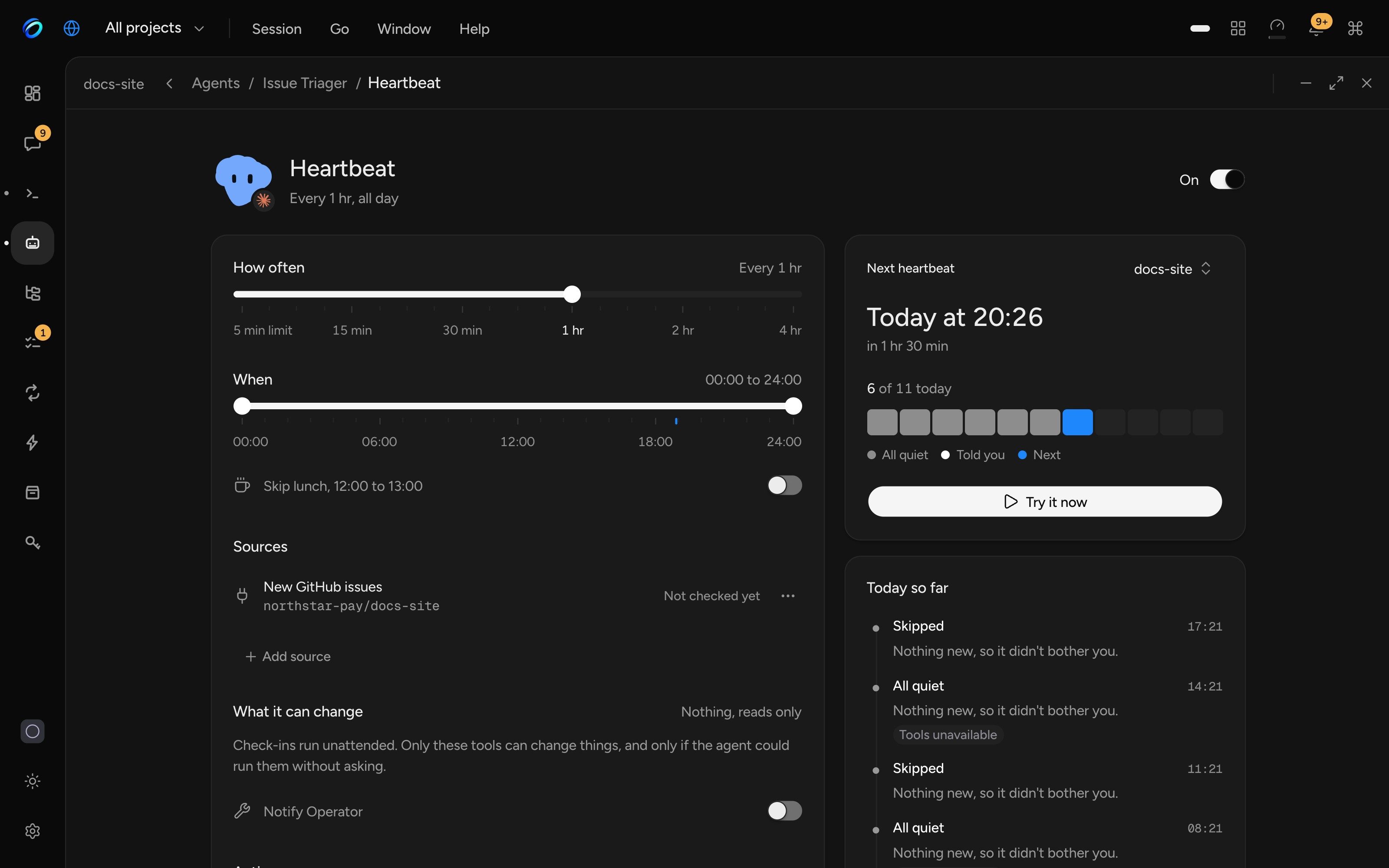
Always-on agents check external sources on each check-in
An always-on agent can now watch something outside CompozyOS, such as new GitHub issues, without paying for a model turn every time it looks. Declare check-in sources in HEARTBEAT.md under context.sources. On each check-in CompozyOS asks every source what is new, without a model, and starts the read-only check only when a source or a built-in fact returned something new. An empty or unchanged result never starts a model turn.
context:
  sources:
    - id: new-issues
      kind: forge-github/issues
      with:
        repo: compozy/compozy
        labels: [bug]
- Two kinds of source. Extensions provide source kinds through the new
heartbeat.sourceprovide surface, and the bundledforge-githubextension shipsforge-github/issues. You can also put your own scripts in the agent'ssources/folder. - Scripts run only after you approve them. CompozyOS runs a script only when its exact hash matches your approval, and editing the script needs a new approval. Approve with
compozy agent heartbeat sources approve <agent> <script>, revoke withcompozy agent heartbeat sources revoke, or use the Check-ins page. Agents can't approve scripts. - Nothing is missed. A source's position advances only after a check has seen its items, so a failed or interrupted check sees the same items again. A source that has more items wakes the agent again at
agents.heartbeat.min_interval. - Failures are visible. Each source reports a typed error and backs off on its own. After
failure_thresholdfailures in a row, the check-in report says so. - Where to find it:
compozy agent heartbeat sources <agent>,sourcesoncompozy agent instance showandcheck --dry-run, the native toolcompozy__agent_heartbeat_sources, the Check-ins page (add, edit, remove and approve sources), and Go/TS SDK helpers with aheartbeat-source-goscaffold. The new guide "Watch new GitHub issues" walks through a setup. - Config:
[agents.heartbeat.sources]setsscripts_enabled,timeout,max_concurrent_polls,max_per_agent,max_items,max_output_bytes,max_state_bytes,failure_thresholdandenv_allow. It is daemon-wide and needs a restart.
Agents without sources work as before.
Migration
- The daemon applies two new database migrations at startup. No existing row or file changes.
- Older daemons reject
context.sources. Upgrade every daemon that reads aHEARTBEAT.mdbefore you add sources to it.
Capture runtime profiles from a running daemon
When the daemon is slow or busy, you can now capture a Go runtime profile from it without restarting. Run compozy daemon profile <kind> --file <path>, where <kind> is cpu, heap, allocs, goroutine, mutex, block or threadcreate.
compozy daemon profile cpu --seconds 30 --file cpu.pprof
go tool pprof -tagfocus session_id=<session-id> cpu.pprof
- CPU, mutex and block captures sample for 1 to 120 seconds (30 by default). Mutex and block sampling is on only during the capture. Only one CPU capture runs at a time; another returns
profile_busy. - Profiles are labeled by session, provider, tool and route, so you can narrow one to a single session. They don't include prompts, file contents, tool arguments or query strings.
- The file is written with owner-only permissions, and an existing file is kept if the capture fails.
This command is experimental. It works only over the local daemon socket: the GET /api/daemon/profile/{kind} route isn't served over HTTP or the Gateway, and app tokens can't use it.
Mark a session's Needs you as seen
A session in Needs you used to stay there until something changed, even after you had looked at it, and a failed session stayed until you archived it. Now you can mark it as seen from the session row menu, the Kanban card, or the button in the session header.
- What it clears: a turn that ended early with no pull request and no open work, a session back from Later, and a failed session. A failed session then reads as stopped and keeps its failure record. The next failure, early stop or Later return raises Needs you again.
- What it keeps: a pending permission, a question waiting for your answer, a missing provider sign-in, or a stop CompozyOS couldn't confirm still need you. Marking those as seen is refused, and the refusal names the answer still owed.
- Marking a child session as seen never wakes its parent.
- From the terminal and agents:
compozy session mark-seen <id>, the native toolcompozy__session_mark_seen, and HTTP/UDSPOST /api/workspaces/{workspace_id}/sessions/{session_id}/mark-seen. A refusal returnsattention_requires_action. Session payloads gainattention_dismissible, which is true only while the current Needs you can be marked as seen.
Migration
The daemon applies a new database migration at startup. Existing sessions are unchanged.
Move a session to another profile
A session started in the wrong profile can now move to another one. Move to profile copies a stopped, top-level session into another active profile and archives the original. The copy keeps the agent, title and conversation, and uses the target profile's agents, credentials and config when it starts. The original keeps its history and past usage in its own profile.
- Where: the session row menu (Move to profile),
compozy session move-to-profile <id> <profile>, and HTTP/UDSPOST /api/workspaces/{workspace_id}/sessions/{session_id}/move-to-profile. Agents usecompozy__session_move_to_profile, which needs the unrestricted workspace-access grant and can't move the agent's own session. - Worktrees move too. A session bound to a worktree gets a new worktree on the same branch in the target profile. Every commit, including unpushed ones, stays on the branch.
- What is refused: running sessions (stop them first), sessions with child sessions, worktrees with uncommitted changes, and worktrees shared with another session. Each refusal returns a
session_move_to_profile_*error that names the rule. - Interrupted moves recover. If a move fails partway, CompozyOS rolls it back. If the daemon stops in the middle, it finishes or rolls back the move at the next start. The session and its branch are never deleted.
compozy session move still moves a session between folders.
Migration
- The daemon applies a new database migration at startup. Existing worktrees keep their behavior.
- Deleting a session now returns 409 while a move of that session is still being recovered. It succeeds once the move settles at the next daemon start or the next move of that session.
Open transcript file paths in your editor from the desktop app
Agents often name files in their replies, such as internal/mcp/hosted_proxy.go:42. In the CompozyOS desktop app, Cmd+click (macOS) or Ctrl+click (Windows and Linux) a file path in an assistant message to open it at that line in your editor. An Open in editor button also appears on hover or focus.
- CompozyOS detects paths in inline code and in links whose whole text is a path, with an optional
:lineor:line:col. Plain text isn't detected. - Relative paths resolve against the session's working directory, then its worktree, then the project root.
- Choose the editor in Settings › General › Editor command, or run
compozy config set desktop.editor_command 'code -g {path}:{line}:{col}'. The value is a command template with{path},{line}and{col}. Left empty, the system text editor opens the file, without line support. - Files outside the session's worktree or project, and credential folders such as
~/.sshand~/.aws, ask you to confirm first. The dialog shows the full path, and Cancel is the default. - The browser and remote clients (LAN, phone, Gateway) show paths as before and can't start anything on the daemon's machine.
desktop.editor_command is set per machine; project and profile config can't set it, and agents can't change it. Single-session reads gain a read-only working_dir field.
Turns wait for a lost provider sign-in and then continue
Switching accounts in a provider CLI, such as signing out of a Claude Code or Codex account near its limit and into another, used to fail every session that sent a prompt in that moment with Authentication required. You then had to resume each one by hand. Now a turn that loses the provider sign-in waits for it to come back and continues by itself, for every ACP provider.
- The session shows "Waiting for the provider sign-in…" with "Retrying automatically · Attempt N of M".
- Retries start after 15 seconds and double up to one a minute, for up to 10 minutes.
- A turn that hadn't started work is sent again as it was. A turn that had already started work gets a short note that the sign-in dropped and that it should check what is done before repeating anything. Your message is never recorded twice.
- If the sign-in doesn't come back in time, the turn fails as it did before. Later turns in that session then fail right away until one completes, instead of each waiting again. Cancelling the prompt ends the wait.
- Session reads show the cause in
runtime.recovery.reason(provider_authorruntime_exit). The existingsession.runtime_recovery.*hooks also fire for these waits.
Configure it in the new global-only [session.auth_recovery] table (enabled, window, initial_delay, max_delay). It needs a restart. Set session.auth_recovery.enabled = false to fail right away, as before.
Fixes
Always-on agents run unattended at Accept edits and Auto-review
An always-on agent at Accept edits (approve-edits) or Auto-review (auto) used to ask you before almost every CompozyOS tool call, including monitors, child sessions, worktrees, status reads and skill reads. The built-in Orchestrator couldn't run unattended unless you copied it at Full access.
- At those levels, CompozyOS tools that change things without destroying them now run without asking. Examples are creating sessions and worktrees, binding a worktree, renaming and linking sessions, task bookkeeping and layouts.
- These still ask: destructive and open-world tools, terminal commands, Loop and Automation tools, config, tool approvals, hooks, extensions, provider model changes, and creating, pausing or resuming agents.
- A call you approve at the provider prompt is no longer asked about a second time.
- CompozyOS tools now follow the session's own permission level, the same level the provider uses.
- The built-in Orchestrator now ships with
permissions: auto.
compozy__session_create runs without asking at these levels and starts the child at the target agent's own level, which can be higher than the caller's.
Other always-on agent fixes:
- The Model row on an agent's home is now the model picker itself. A change saves at once, and Use default clears the agent's own choice.
- Add always-on agent is in the session list toolbar
+in every view, not only in a project row. - Changing an agent's avatar or color from its profile header saves again instead of failing with
invalid agent definition appearance. An unsupported saved appearance no longer fails an agent read orcompozy agent duplicate; the copy gets the default face. - Cancelling your own monitor with
compozy__monitor_cancelno longer reports "A wake-up didn't arrive".
Stopping the daemon no longer records running agents as crashed
When the daemon was stopped from outside while a session was mid-turn, for example by logging out of the OS, shutting down or quitting the desktop app, the session was recorded as failed with "ACP subprocess exited unexpectedly". That also wrote a crash bundle, fired agent.crashed, tried to restart the agent and sent the parent a failed wake.
Now an agent that exits while the daemon is shutting down is recorded as stopped by the daemon. No crash bundle or agent.crashed follows, the daemon doesn't restart agents while it stops, and a parent gets a stopped wake. After a restart, the interrupted turn still continues. An agent that exits while the daemon keeps running is still a crash.
Less repeated work when many sessions run
A round of fixes from a performance review of many sessions running at once.
- Clicks no longer stall in the desktop app. Clicks on sessions and window tabs could hang for tens of seconds and then apply all at once, with "Can't save window layout — retrying". Three long-lived streams held half of the browser's connections; they now use WebSocket. A window command still waiting after 8 seconds is dropped instead of replayed.
- Skills are reparsed only when they change. A failed extension refresh no longer leaves skill discovery stale, and healthy profiles and projects stay usable when one fails.
- Fewer catalog reads and writes. Window transcripts follow the 5-second refresh window, cached catalogs are written only when they change, and pending-answer views refresh from the live stream instead of polling every 5 or 15 seconds.
- Model discovery stops retrying sources that can't work, such as a missing CLI. Refresh still tries them, and temporary failures still retry, backing off to at most 2 hours.
- The desktop app caps its HTTP cache at 256 MiB and trims a larger one at launch. Your data and sign-ins are kept.
- Cancelled requests return 499 and no longer log as server errors.
Many sessions no longer wait on one database lock
With around 30 active sessions, transcript updates, session health, model refreshes, process checks and a large event-summary log all waited on the same SQLite resources, so the app and agents slowed down together. CompozyOS now keeps that work apart.
- Interactive writes, such as sending a prompt or changing a session, go ahead of background work, which waits in a bounded queue.
- Global, profile and session reads have their own read pools, and transcript work is prepared before it takes the write lock.
- Session health is written in batches every 500 ms and flushed on a clean shutdown.
- Event summaries move to their own database,
$COMPOZY_HOME/compozy.db.telemetry.db, which has its own write lock.
CLI commands, HTTP/UDS routes, native tools, Observe filters and cursors, hooks and config keys are unchanged.
Migration
- On the first start after the upgrade, the daemon moves existing event summaries into
compozy.db.telemetry.dbin small batches and checks every row before it removes the old copy. On a large installation this first start takes longer and needs disk space for the new file. An interrupted move resumes at the next start. - Back up and restore
compozy.db,compozy.db.telemetry.dband their-waland-shmfiles together. The two databases carry a matching identity. If the telemetry file is missing, empty or comes from another installation, the daemon refuses to start instead of replacing it; restore both files from the same backup. See Operations › Database for a live backup recipe.
Profiles stay separate across windows, routes and reads
A review of how profiles are kept apart found and closed several gaps.
- Switching profiles closes the other profile's windows. A session, terminal, agent or automation window opened under All profiles no longer stays on screen with "This session belongs to …" after you switch into one profile. It leaves the desk without stopping anything, so another profile's terminal keeps running, and you can reopen the window.
- Agents open in their own profile. Opening an always-on agent owned by another profile from All profiles no longer shows "Agent not found". Its window, New session and Duplicate use the agent's profile.
- Routes check the session's profile. Project session routes (prompt, transcript, stream, usage and the rest) now return 404 for a session owned by another profile when you select a profile.
all_profiles=trueallows reads and refuses writes withprofile_selection_conflict. Without a selector, a route still uses the session's own profile. - Agent-instance writes refuse
all_profiles=true. Pause, resume, check, archive and the other instance writes can no longer reach another profile's instance through the aggregate. - One rule for
all_profilesreads. Terminal lists, details, streams and downloads, agent-instance lists and details, and the native toolscompozy__agent_list,compozy__agent_instance_get,compozy__agent_instance_listandcompozy__agent_activityacceptall_profilesthe same way, with rows labeled byprofile_name. The instance list no longer returns 422. - The command palette sees only your profile's clients. A palette call can no longer list, read or send commands to a browser tab open on another profile.
compozy cmd-palette clients --all-profilesandGET /api/cmd-palette/clients?all_profiles=truestill list every profile. - Renaming a profile keeps row actions working. Rename, archive, Later and Move to profile on that profile's sessions no longer fail with
profile_not_founduntil a reload. - An archived profile no longer stops the daemon from starting. The daemon used to exit with
start provider usage: profile "<name>" is archived, which left the desktop app on its boot error screen.
Migration
Scripts that called project session routes with profile=<other> for a session owned by a different profile now get 404. Name the owning profile, leave the selector out, or use all_profiles=true for reads. GET /api/cmd-palette/clients now defaults to your profile; pass all_profiles=true for the old list.
Provider usage for extra accounts and verified native CLI sign-ins
Two fixes for running more than one native CLI account.
- Usage for custom providers. A custom provider that points at a built-in, such as a second Claude account with
runtime_provider = "claude"andauth_mode = "native_cli", used to showunsupported/no_collectorin Provider usage. It now uses the matching collector and shows as its own row. Usage collection also applies anenv NAME=value … cmdlaunch prefix, so each account reads its own config folder, such asCLAUDE_CONFIG_DIR=~/.claude-mm1, instead of mixing with your main account. - "Sign-in unverified" no longer sticks. Settings › Providers and
compozy provider listshowed "Sign-in unverified" for everynative_cliprovider, even right after a sign-in check passed. The daemon now remembers the last result fromcompozy provider auth status, from Check sign-in, and from session starts, and shows when it checked. Check sign-in now checks in place instead of opening the editor. Changing the provider's config, or restarting the daemon, clears the remembered result.
Smaller fixes
- Mermaid diagrams: the mouse wheel scrolls the transcript when the pointer is over a diagram.
- Worktrees:
compozy worktree removeworks when the worktree's base branch was merged and deleted, instead of failing withworktree_safety_check_failed. It checks for commits no other branch, tag or remote keeps. - Agents sending prompts:
compozy__session_promptno longer returns a schema error for a prompt that was queued, held or sent to another session. The prompt was always delivered. - Loop templates accept
eq,ne,lt,le,gt,ge,not,andandor, so a step can see which gate rejected the last attempt. - Session list: rows are less crowded, and built-in agents have icons.
- Session header: a session with several linked pull requests shows one "N linked PRs" chip that opens the list, instead of one PR plus
+N.