Historical release post: Networks, Bridges, and the product Sandbox described in this post have since been removed. Tasks, autonomy, Goal, HEARTBEAT.md, and SOUL.md remain supported. See the current migration notes.
Most agent orchestration tools put you in an uncomfortable spot. Either you write every loop, branch, and retry condition in code with no visual representation of what's actually happening, or you hand your execution environment to a cloud provider and expose a public endpoint just to receive a webhook. Neither option is great when you're building locally and trying to move fast.
LangGraph, Temporal, Inngest, CrewAI, and Windmill are capable tools. But their trigger models are built for cloud-hosted environments. If you want a GitHub push or a Linear issue to kick off agent work, you typically need a public URL — which means deploying early, running a tunnel like ngrok, or wiring up a cloud function just to catch the event. The graph you define in code stays in code, and while some of these tools have added inspection surfaces, those surfaces reflect LLM-call graph execution rather than a durable agent session with permissions and memory.
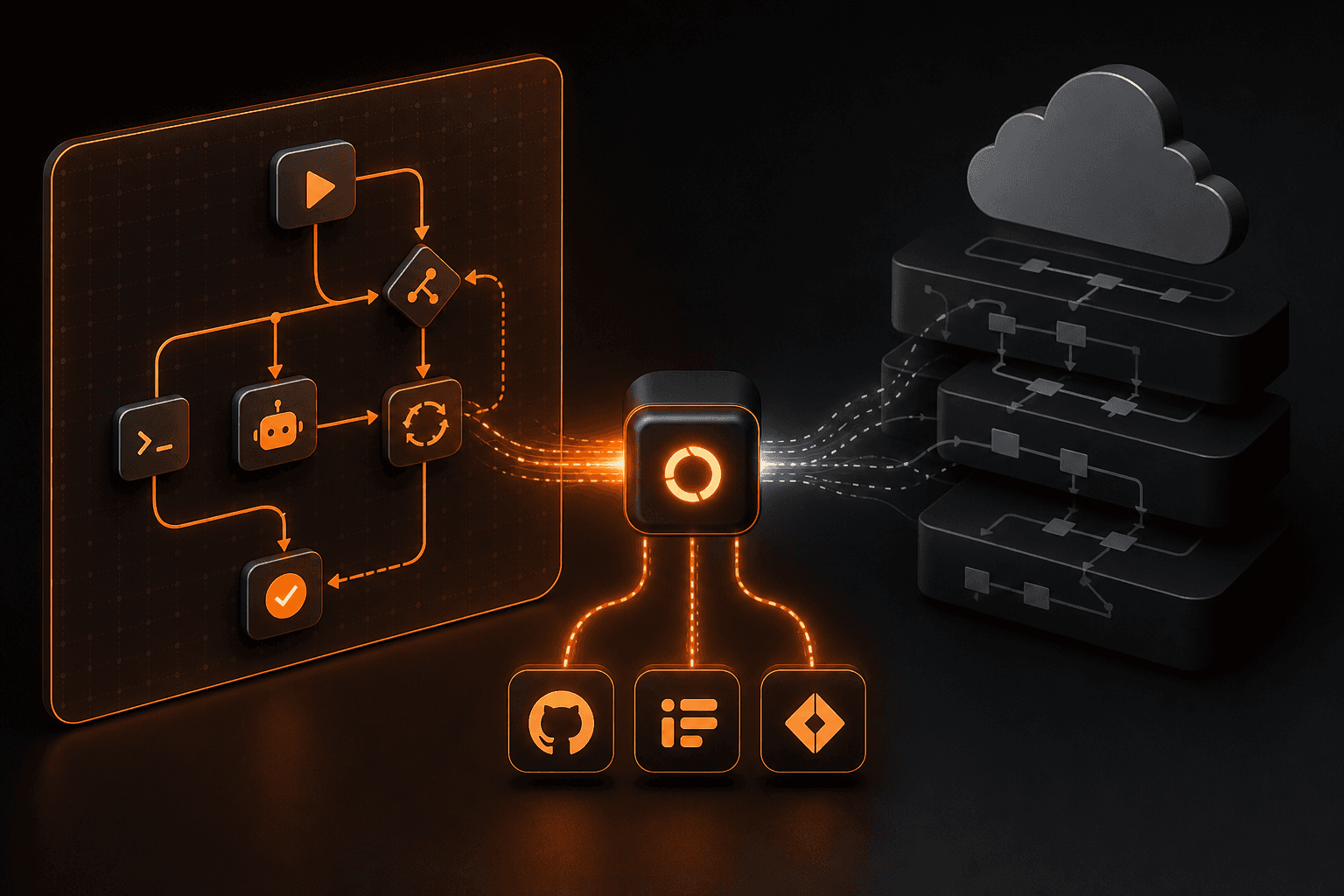
CompozyOS takes a different approach. Two specific features set it apart: a built-in graph editor where a single canonical definition drives both the visual surface and execution, and a local gateway that lets signed webhooks trigger work directly on your machine — with explicit, granular controls over what is and isn't exposed. This article explains both, with the real commands and definitions.
The problem with code-only graphs and cloud-hosted triggers
Graphs that live only in your head
LangGraph is a well-regarded framework for building stateful, multi-step agent workflows. The graph is defined entirely in Python — nodes, edges, conditional branches — and the mental model of the flow lives in your head or in documentation you maintain separately. LangGraph Studio provides a visual inspection surface, but it renders the graph after the fact from the code definition. When the workflow gets complex, with multiple loops, parallel branches, and conditional retries, the gap between the code and the actual execution path widens fast.
Temporal takes a similar stance. Workflows are code-first, and Temporal's Web UI provides event history and run inspection — which is genuinely useful. But that inspection is of workflow execution history, not of a durable agent session with its own permission model, memory state, and task queue. The graph itself isn't something you design visually; you write it, deploy it, and then observe it.
CrewAI has moved toward a visual editor in its enterprise offering, which is a genuine step forward. But that editor generates workflow definitions that run on CrewAI's hosted runtime. The visual representation and the execution environment are separate concerns, and there's no single canonical definition that the editor and the file-based path both validate against.
Triggers that need a public address
Cloud-hosted orchestration platforms handle triggers well once you're deployed. Inngest, for example, is built around the idea that your functions register with Inngest's cloud and events flow through that cloud to invoke them. That works cleanly in production. During local development, you run a local Inngest dev server that proxies events — which adds a setup step and ties your local environment to an external service's availability.
Temporal Cloud and LangGraph Platform follow a similar pattern. Webhooks from external services need to reach a cloud-hosted endpoint. If you want to test a GitHub webhook locally, you're setting up a tunnel or standing up a staging environment. Neither is catastrophic, but both add friction at exactly the moment when you want to iterate.
One canonical definition, three surfaces
What the definition actually looks like
A Loop is compozy.loop/v1 YAML on disk, one directory per Loop, always named loop.yaml. It is
data, not a program of inline functions — which is what makes it renderable as a graph without a
translation step. Here is a trimmed version of review-and-fix, a Loop that ships inside the
CompozyOS spec-cycle extension:
apiVersion: compozy.loop/v1
kind: Loop
meta:
  name: review-and-fix
  description: Review a task with an agent and remediate every finding until a round comes back clean.

concurrency: forbid

inputs:
  task_name:
    type: string
    required: true
  reviewer:
    type: agent
    default: reviewer
  fixer:
    type: agent
    default: review_fixer

contract:
  goal: "Review the work for task {{ .inputs.task_name }} and remediate every valid finding."
  stop_when: "nodes.review.status == 'succeeded' && size(nodes.review.output.issues) == 0"
  iteration_cap: 3
  no_progress:
    window: 2
    hash_fields: [nodes.review.output.issues]
  terminal_states: [done, no-op, blocked, failed, exhausted, stalled]

graph:
  nodes:
    - id: review
      class: action
      kind: run-agent
      timeout: 45m
      retry:
        max_attempts: 2
      params:
        agent: "{{ .inputs.reviewer }}"
        prompt: "Review the workspace changes for task {{ .inputs.task_name }}."

    - id: has_issues
      class: control
      kind: branch
      condition: "size(nodes.review.output.issues) > 0"

    - id: fix_issues
      class: control
      kind: fan-out
      collection: "{{ .nodes.review.output.issues }}"
      max_parallel: 1
      max_fan_out: 64

    - id: fix_issue
      class: action
      kind: run-agent
      params:
        agent: "{{ .inputs.fixer }}"
        prompt: "Remediate {{ .item.title }} in {{ .item.file }}."

  edges:
    - from: review
      to: has_issues
    - from: has_issues
      to: fix_issues
    - from: fix_issues
      to: fix_issue

start:
  - kind: manual
  - kind: cli
  - kind: webhook
Two grammars share the file, and the split is deliberate. String values are Go templates —
{{ .inputs.task_name }}, {{ .item.file }}. Conditions are CEL — condition, stop_when, and
event filters. A condition that doesn't evaluate to a boolean is a lint error, not a runtime
surprise.
Note what is not in the graph. Retry has two distinct meanings and the DSL keeps them apart:
retry.max_attempts on a node is operational retry for a transport failure or an attempt timeout,
while the actual review loop is generational — stop_when, iteration_cap, and no_progress
bound the whole body, and a gate node maps a verdict to a route like revise under a
max_revisions ceiling.
The editor lints with the daemon's linter
The visual editor at /loops/:name/editor is a fork-and-edit surface, not a blank-canvas builder:
you fork an existing Loop and edit its body. A palette on the left, a canvas of node cards and edges
in the center, an inspector on the right whose fields are generated from the canonical DSL types and
the tool registry's own schemas — never an editor-local model.
The part that matters is the linter dock. It reports; it never computes. The editor calls the same route the CLI calls:
$ compozy loop validate --file loop.yaml -o jsonA clean definition returns 200 with {"valid": true}. A broken one comes back 422 with
per-node, deterministic codes:
{
  "valid": false,
  "errors": [
    {
      "node_id": "fix_issues",
      "code": "fan_out_ceiling_exceeded",
      "message": "max_fan_out (80) exceeds the daemon ceiling of 64",
      "severity": "error"
    }
  ]
}
Those codes are a closed catalog owned by the runtime — cycle, unreachable_node,
non_terminating_structure, node_id_invalid, verdict_policy_requires_judge, unknown_reference,
unsafe_command_interpolation, and around fifty more. Validate lints and compiles the draft without
saving it. Publish is a separate, compare-and-swap operation: PATCH /loops/:name with an
expected_version, rejected 409 if the stored version moved while your editor was open.
That's a checkable property, not a claim about visual fidelity. Compare it to CrewAI Studio, where the visual editor and the file-based path are separate surfaces with separate validation, so a workflow that looks correct in the editor may behave differently when run from a file.
A local gateway with explicit exposure
There is no "expose everything" flag
CompozyOS binds to loopback by default and nothing becomes reachable implicitly. Exposure is a
tier × surface matrix, and each cell is an explicit transition you run on purpose. Two tiers —
private (your own Tailscale tailnet) and public — and two surfaces — operator_ui and
webhook_ingress.
gateway.enabled in config.toml is a machine-wide ceiling, not a switch that exposes anything by
itself:
$ compozy config set gateway.enabled true
$ compozy gateway provider enable tailscale --tier private --source bundled

# Private overlay: the web UI over your own tailnet, nothing public
$ compozy gateway surface enable operator_ui --tier private

# Public delivery: signed webhooks only — the listener is built with delivery routes and nothing else
$ compozy gateway surface enable webhook_ingress --tier public

# Public operator access: requires explicit consent, on top of device pairing
$ compozy gateway surface enable operator_ui --tier public --consent
Each cell is independent — enabling one does not enable another. Skip the ceiling and every later transition refuses, naming both the cause and the fix:
gateway exposure refused: gateway.enabled is false and blocks every remote transition; fix: set gateway.enabled=true, then retry the explicit transitionExposure intent is durable daemon state, not a config value, which is why there's no
gateway.public_ui.enabled key to find. compozy gateway status -o json is where the proof lives:
{
  "tiers": [{ "tier": "private", "observed": "up", "advertised": true }],
  "providers": [{ "name": "tailscale", "tier": "private", "health": "healthy" }],
  "addresses": [
    {
      "tier": "private",
      "address": "https://compozy-gateway.<your-tailnet>.ts.net:8443",
      "live": true
    }
  ]
}
Reachability is proven before an address is advertised
Before the daemon advertises any address, it mints a one-time challenge — a random nonce served at
/.well-known/compozy/gateway-challenge/<id> — and fetches it back through the address the
provider just claimed. The address goes live: true only on a byte-exact nonce echo.
On the public tier that check is deliberately paranoid: HTTPS is mandatory, redirects are refused, the response body is capped, and DNS resolves through an authenticated DNS-over-TLS resolver rather than the host resolver — specifically so a Tailscale MagicDNS answer can't be mistaken for proof that a public Funnel address works.
This is a reachability check, not authentication. Trust is separate and never conflated with it: every device completes a pairing step, and every delivery is signed, regardless of which address reached the daemon.
Remote reach is not remote authority
Being reachable doesn't make a daemon fully operable from the outside. The remote operation matrix is enforced twice — structurally, because remote listeners are built with a fixed route set so local-only routes literally do not exist on them, and again as a client-side denylist.
Honest limits
The relevant comparison for the gateway isn't LangGraph, Temporal, or Inngest — those are cloud-hosted by design, so "local beats cloud" illuminates nothing. The useful comparison is against other local-first tools: OpenHands, Orca, Conductor, Emdash, and Smithers. They share the local-execution posture, but none of them prove reachability before announcing an address, and none expose the same granular, independently managed cells.
Putting it together: an event that starts a Loop
Say a Linear issue moving to "In Progress" should start the review-and-fix Loop. That's one
automation trigger:
$ compozy automation triggers create \
    --name spec-review \
    --scope workspace \
    --workspace /Users/you/src/checkout-api \
    --event webhook \
    --endpoint-slug spec-review \
    --webhook-secret-value "$SPEC_REVIEW_SECRET" \
    --loop review-and-fix \
    --loop-input-mapping 'task_name={{ .trigger.payload.issue.identifier }}'
The equivalent declarative form in config.toml:
[[automation.triggers]]
scope = "workspace"
workspace = "/Users/you/src/checkout-api"
name = "spec-review"
event = "webhook"
endpoint_slug = "spec-review"
webhook_secret_ref = "env:SPEC_REVIEW_SECRET"
target_kind = "loop"
enabled = true
fire_limit = { max = 6, window = "1h" }

[automation.triggers.loop_target]
loop_name = "review-and-fix"
input_mapping = { task_name = "{{ .trigger.payload.issue.identifier }}" }
Deliveries land on a path that carries both the slug and the webhook id:
POST /api/webhooks/workspaces/<workspace-id>/spec-review--wbh_<id>Now the part most articles would gloss over: CompozyOS verifies its own signature contract, not
GitHub's or Linear's. Every delivery carries three headers, and the signature is an HMAC-SHA256
over the timestamp, a literal ., and the raw body:
$ TS=$(date +%s)
$ BODY='{"issue":{"identifier":"CHK-421"}}'
$ SIG=$(printf '%s.%s' "$TS" "$BODY" \
    | openssl dgst -sha256 -hmac "$SPEC_REVIEW_SECRET" -hex \
    | awk '{print $2}')

$ curl -X POST "https://compozy-gateway.<your-tailnet>.ts.net/api/webhooks/workspaces/$WS/spec-review--wbh_$ID" \
    -H "X-Compozy-Webhook-Timestamp: $TS" \
    -H "X-Compozy-Webhook-Signature: sha256=$SIG" \
    -H "X-Compozy-Webhook-Delivery-ID: $(uuidgen)" \
    -H 'Content-Type: application/json' \
    -d "$BODY"
Timestamps outside a five-minute freshness window are rejected, and a replayed delivery id is rejected while it's still inside that window.
Publishing the URL is its own confirmation step, too. A trigger read exposes an ingress object once
the public surface has a verified address, and you confirm the binding explicitly via
POST /api/gateway/ingress-bindings. If the public address changes, the endpoint generation changes
and the trigger reports reconfirmation_required until you confirm again. A URL existing is never
proof that delivery is on.
From there you can adjust the Loop's stop_when, swap the agent — CompozyOS ships 26 built-in
providers, including Claude Code — and rerun without redeploying anything. The same definition, lint
codes and all, is what moves to production when you're ready.
Who this is for
CompozyOS is a beta product, free to self-host. It's built for developers comfortable with a CLI who want infrastructure that handles the operational concerns of agent work — loops, memory, queues, permissions — without writing that infrastructure themselves.
If you're already running agent workflows in production on LangGraph Platform or Temporal Cloud and the cloud-hosted trigger model works for your team, CompozyOS isn't solving a problem you have. But if you're in the phase where you're building, iterating, and testing locally — and you want one canonical definition that validates identically whether you edit it visually or in a file, plus a gateway that makes every inch of exposure an explicit decision — the combination is worth a look.
Start with the Loops DSL reference, the visual editor, and the gateway quickstart.
Frequently asked questions
Why does receiving a webhook locally matter? Webhook triggers let external services start agent work when an event occurs. Receiving them without a public endpoint means you can test the full trigger-to-execution path on your machine before deploying anything — no tunnel, no staging environment.
How does the local gateway control exposure?
Exposure is a tier × surface matrix: private and public tiers, operator_ui and
webhook_ingress surfaces. Each cell is enabled by an explicit
compozy gateway surface enable <surface> --tier <tier> transition, and the public operator UI
additionally requires --consent. gateway.enabled in config.toml is a ceiling above all of them,
not a switch. Exposure intent is durable daemon state — there is no config key that turns the public
UI on.
What are the gateway's real limitations? No store-and-forward: a delivery arriving while the daemon is offline is lost. A fixed-window rate limit of 60 requests per minute per endpoint path and transport source, not configurable, covering webhook ingress. Payloads cap at 1 MiB. And remote reach is not remote authority — task mutations, scheduler authority, the agent kernel, hosted MCP, and resource mutations stay local-only.
Can GitHub or Linear deliver to it directly?
Not with their native signatures. CompozyOS verifies X-Compozy-Webhook-Timestamp,
X-Compozy-Webhook-Signature, and X-Compozy-Webhook-Delivery-ID — an HMAC-SHA256 over
"<timestamp>." + body. Send from a workflow step that signs that contract.
What makes the graph editor different from CrewAI Studio?
The editor and the file-based path share one canonical compozy.loop/v1 document and one linter. The
editor calls POST /loops/:name/validate — the same route the CLI calls — and surfaces the daemon's
own per-node codes such as fan_out_ceiling_exceeded and verdict_policy_requires_judge. CrewAI
Studio's editor and file path are separate surfaces with separate validation.
How is this different from Temporal's Web UI or LangGraph Studio? Temporal's Web UI shows event history for workflow runs, and LangGraph Studio renders LLM-call graph execution — both genuinely useful. The CompozyOS editor inspects a durable agent session: permissions, memory state, task queue, and the definition itself, all validated by the same path. You're looking at the session's infrastructure state, not just a trace of LLM calls.
Does CompozyOS require a cloud account? No. It's designed to be self-hosted, and the beta is free to self-host. The private overlay uses your own Tailscale account — CompozyOS operates no relay and no Tailscale infrastructure of its own.
Which agent providers does it support? 26 built-in providers, including Claude Code, Codex, Gemini, OpenCode, Goose, OpenHands, and Cursor. Swapping the provider on a node doesn't change the Loop's structure.
Is it suitable for production? CompozyOS is in beta. It suits developers building and testing agent work locally, and you can self-host the runtime with the same definitions you developed locally. But the gateway's lack of store-and-forward makes missed deliveries during downtime a real operational consideration.